Experience Certificate for Government Jobs: Format & Tips
Many government and public sector job notices now ask for work experience along with a degree. Bank officer posts, specialist posts, legal and IT roles, and many contract jobs say you need “post-qualification experience” of two, three or five years. When you apply, you only fill in the details in the online form. But later, at the document verification or interview stage, you must prove it with an experience certificate for a government job. If the certificate is weak, unclear or missing, your candidature can be cancelled even after you clear the exam.
This guide explains what an experience certificate is, what it must contain, how to count your experience correctly, and the common mistakes that cost candidates their selection.
What Is an Experience Certificate for a Government Job?
An experience certificate is a letter issued by your employer that confirms you worked there, in which role, and for how long. Recruiting bodies use it to check that you meet the experience condition given in the notification. It is different from an offer letter or an appointment letter: those only show that you were hired, while the experience certificate shows what you actually did and for how long.
For example, the SIDBI Grade A & B Recruitment 2026: 68 Posts, Apply by 11 Dec notice asks for at least two years of post-qualification experience in specific areas such as lending, risk, treasury or audit for its General stream, and different experience for other streams. Candidates applying to posts like these must be ready to prove it with proper certificates.
What Does “Post-Qualification Experience” Mean?
Post-qualification experience is the work you did after you earned the qualification the notice asks for. If the essential qualification is a graduation degree, only the work done after your graduation result counts. Work done during your studies, internships or before you finished the required degree usually does not count, unless the notice says otherwise.
How is experience counted?
Most notices give a “cut-off date” for experience. You count your experience from the date you joined after getting the qualification up to that cut-off date. If you are still working, the certificate should clearly say so and give your joining date. Always read the notice for its own cut-off date, because it differs from one recruitment to another.
Does the type of employment matter?
Yes. Notices often say which type of employment is accepted, for example permanent, full-time direct contract or third-party payroll. Some posts accept third-party payroll experience and some do not. Some also limit the type of organisation, such as scheduled commercial banks, government departments or regulated financial companies. Check that your employer and your employment type are both in the allowed list.
What Must an Experience Certificate Contain?
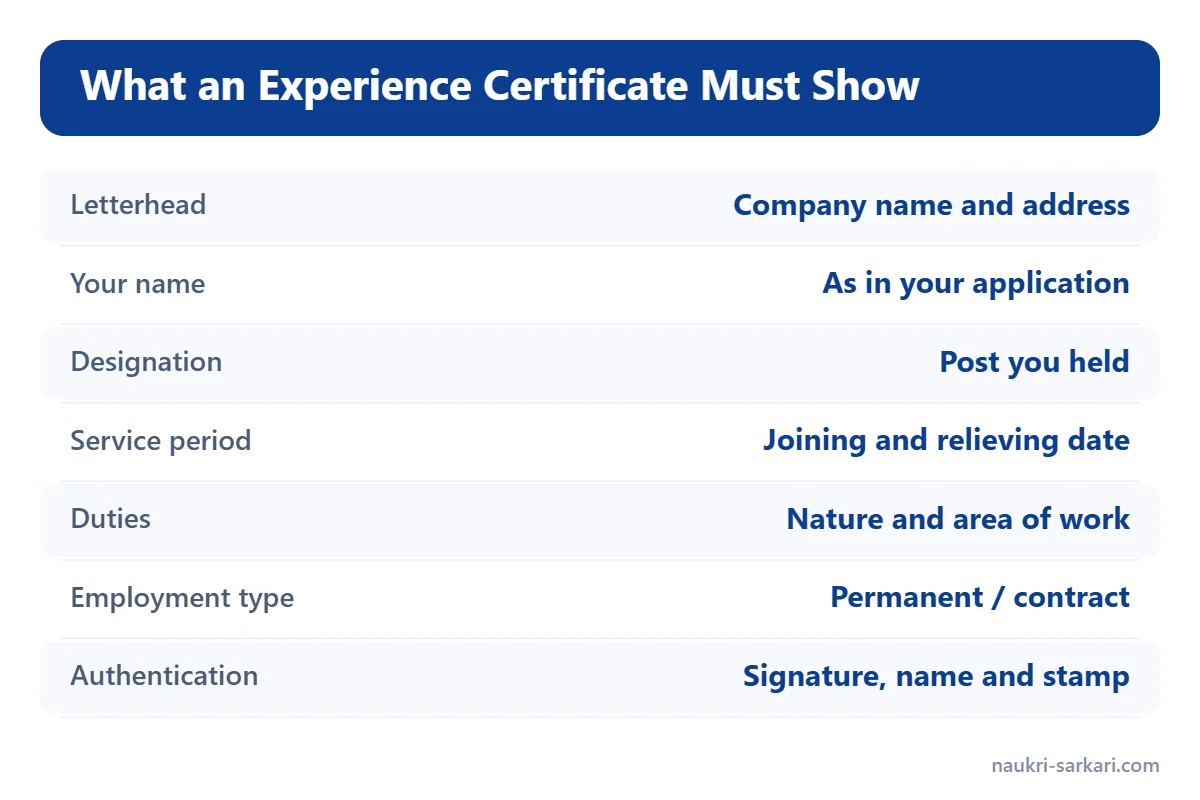
A good experience certificate leaves no doubt for the verification officer. It should include:
| Detail | Why it matters |
|---|---|
| Company letterhead with full address | Shows the certificate is issued by the employer |
| Your full name as in your application | Avoids mismatch during verification |
| Designation or post held | Shows the level of your role (for example officer or clerk) |
| Exact joining date and relieving date (or “currently working”) | Used to count your total experience |
| Nature of duties and the area of work | Many posts accept only experience in specific areas |
| Type of employment | Permanent, contract or third-party payroll, as asked in the notice |
| Date of issue, signature, name and designation of the signing officer | Makes the certificate valid and traceable |
| Office seal or stamp | Adds proof of authenticity |
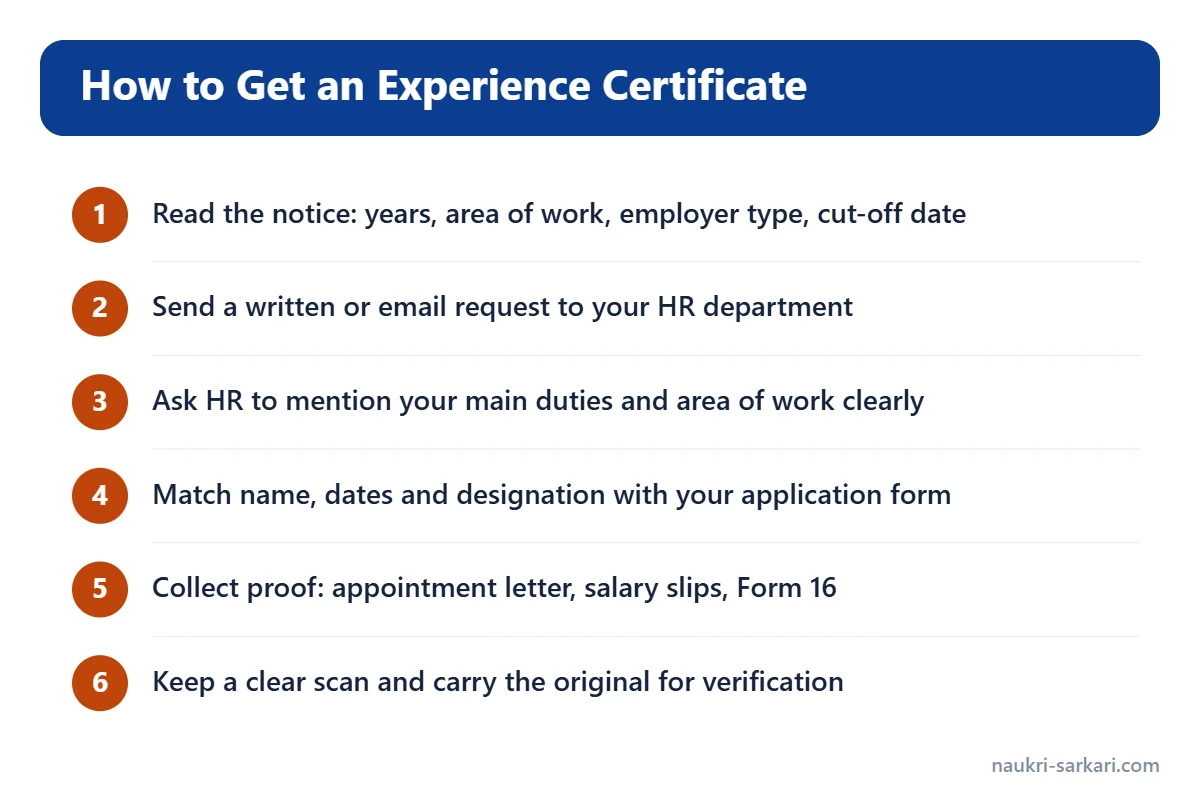
How to Get an Experience Certificate: Step by Step
- Read the notice first. Note the exact experience asked for: number of years, area of work, type of employer and the cut-off date.
- Write to your HR department. Send a written or email request for an experience certificate and mention that it is for a government job application.
- Ask for duties to be mentioned. Request that your main duties and the area of work are written clearly, matching the language of your actual job.
- Check every detail. Match your name, dates and designation with your application form and other documents.
- Collect supporting proof. Keep your appointment letter, salary slips, Form 16 or bank statements showing salary credit for the period.
- Keep scanned and original copies. Upload a clear scan if the form asks for it, and carry the original at document verification.
Which Supporting Documents Help Prove Experience?
An experience certificate is the main proof, but verification officers may ask for more, especially if you have worked on contract or with more than one employer. Keep these ready:
- Appointment or offer letter for each job
- Relieving letter from previous employers
- Salary slips for the period of work
- Form 16 or income tax records
- Bank statement showing salary credits
- Contract agreement, if you worked on a contract
Our Document Verification for Government Jobs: Full Checklist explains how to arrange all your documents in order before the verification day.
What If You Are Still Working With the Same Employer?
Many candidates apply while they are still in their current job. In this case, ask HR for a certificate that says you are “currently working” with your joining date and present designation. Some recruiting bodies also ask for a No Objection Certificate (NOC) from your current employer, especially if you are already in a government or public sector job. Read the notice carefully to see whether an NOC is required at the time of applying or only at joining.
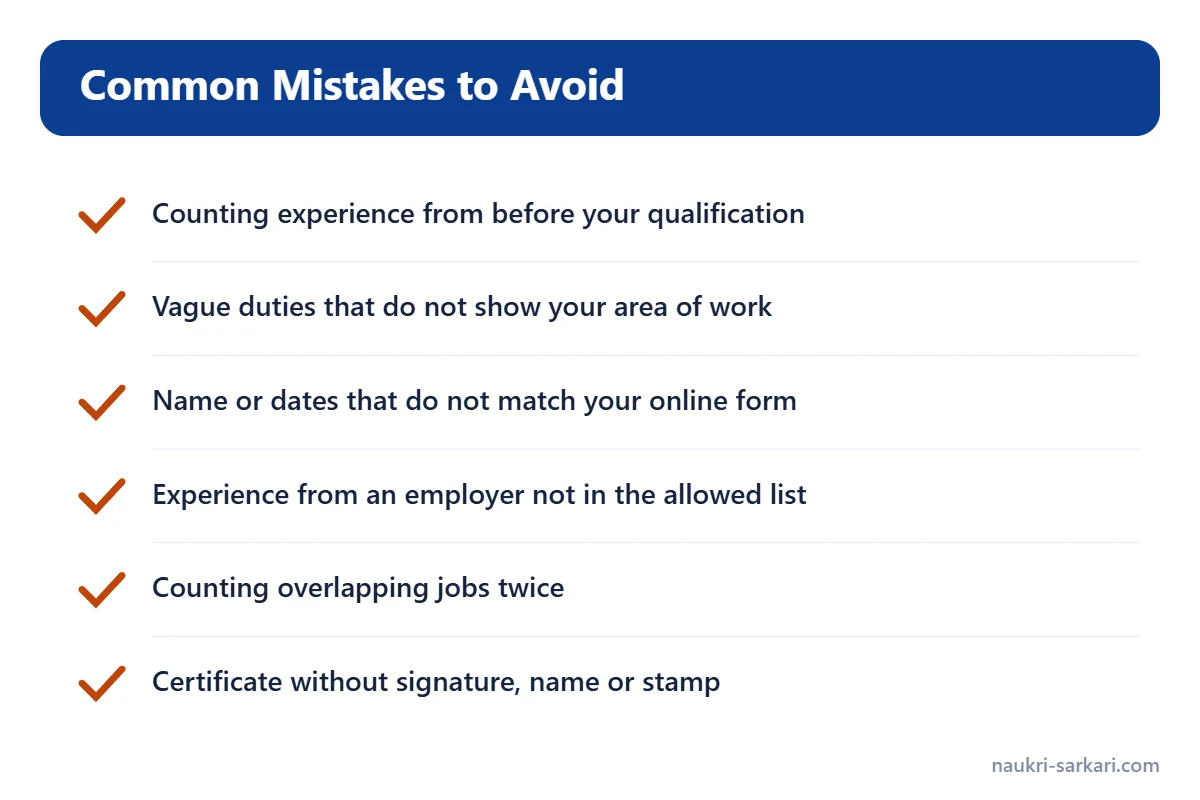
Common Mistakes to Avoid
- Counting experience before the qualification. Only post-qualification work counts when the notice says so.
- Vague duties. A line like “worked in the company” may not prove experience in a specific area such as credit, audit or IT.
- Name or date mismatch. Dates in the certificate must match what you entered in the online form.
- Wrong type of employer. Experience from an organisation that is not in the allowed list may be rejected.
- Adding up overlapping jobs. If two jobs overlap in time, the same period cannot be counted twice.
- Unsigned or unstamped letters. Always check for signature, name of the signing officer and stamp.
How Experience Is Entered in the Online Form
In most online forms, you add each job as a separate entry with employer name, post, joining date, leaving date and nature of duties. The system often calculates your total experience automatically. Fill these details exactly as they appear on your certificates. If you are new to online applications, see How to Fill a Government Job Online Form: Step-by-Step Guide.
Other Updates From Today
If you are preparing for exams this season, these updates from today may also help:
- CSIR NET December 2026 City Slip Out: Download Link & Steps
- BPSC Research Officer Prelims Result 2026 Out: 33 Qualify
- University & Board Exam Updates: 28 November 2026
You can find all open vacancies in our Latest Jobs section and bank vacancies in Bank Jobs.
Frequently Asked Questions
Is an offer letter enough to prove work experience?
Usually not. An offer letter only shows you were hired. An experience certificate or relieving letter, along with salary proof, shows how long you actually worked.
Does internship count as work experience for government jobs?
In most cases, no, especially when the notice asks for post-qualification experience. Always follow what the specific notice says.
Can I combine experience from two employers?
Many notices allow combined experience from more than one eligible employer, as long as the periods do not overlap. Check the notice, because some posts accept only specific types of organisations.
What if my old company has closed?
Keep whatever proof you have, such as the appointment letter, salary slips, bank statements and tax records. Whether these are accepted depends on the recruiting body, so check with the helpline given in the notice.
Is third-party payroll experience accepted?
It depends on the post. Some notices accept third-party payroll experience and some ask only for permanent or direct contract service. Read the eligibility section carefully.