Normalisation of Marks in Government Exams: How It Works
Every year thousands of candidates ask the same question after a big recruitment exam: my friend and I attempted the same number of questions, so why are our marks different? The answer is almost always normalisation of marks in government exams. If your exam was held in more than one shift, the number that decides your merit is not your raw score at all.
This guide explains what normalisation is, why recruitment boards use it, how it is applied, and where you can actually see your own normalised score. No formulas to memorise, just the part that affects your result.
What Is Normalisation of Marks in Government Exams?
When a recruitment exam has lakhs of candidates, no board can seat everyone in one hall on one day. The exam is split into shifts, and each shift gets a different question paper. The papers follow the same syllabus and the same pattern, but they are never exactly equal in difficulty. One shift may get a slightly tougher reasoning section; another may get an easier general knowledge section.
Normalisation is the statistical adjustment that corrects for this. It converts the raw marks of every shift onto one common scale, so that a candidate is neither rewarded nor punished for the shift they happened to be allotted. The adjusted number is your normalised score, and that is the figure used to prepare the merit list.
Why Boards Use It
Without normalisation, the shift you were allotted would partly decide your selection. That is not something any candidate controls, so boards treat it as unfair. Normalisation exists to remove that element of luck.
It matters most in exams where the cut-off is decided by a fraction of a mark. In a recruitment with tens of thousands of posts and lakhs of applicants, a difference of half a mark can move a candidate several thousand ranks. Comparing raw scores across papers of unequal difficulty would make that ranking meaningless.
How Normalisation Is Applied
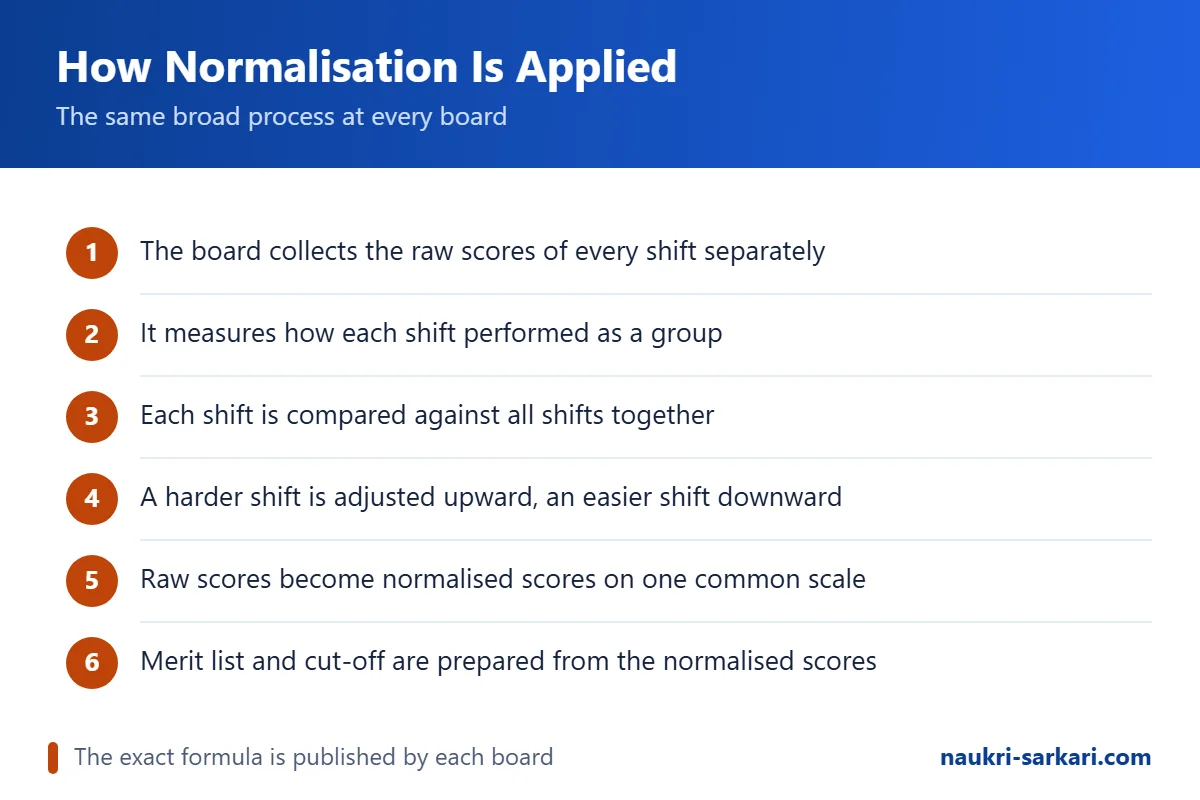
The exact formula is decided by each board and is published in its own notification or information bulletin. The broad process, however, follows the same shape everywhere:
- The board collects the raw scores of every shift separately.
- For each shift it works out how that shift performed as a group, using measures such as the average score and the spread of scores.
- It compares each shift against the overall picture of all shifts together.
- A shift whose paper turned out harder is adjusted upward; a shift whose paper turned out easier is adjusted downward.
- Every candidate's raw score is converted into a normalised score on the common scale.
- The merit list, cut-off and final selection are prepared from these normalised scores.
Because the adjustment is based on how an entire shift performed, no individual candidate can influence it, and no agency can change it for you.
Raw Score and Normalised Score Are Not the Same Thing
| Raw score | Normalised score |
| Marks you actually scored in your paper | Those marks placed on a scale common to all shifts |
| Can only be compared within your own shift | Can be compared across every shift |
| Often shown with the answer key and objection window | Usually published later, with or after the result |
| Not used for the final merit list | Used for the merit list and the cut-off |
Where You Can See Your Normalised Score
Boards do not always release normalised scores at the same time as the result. Some publish them along with the result, some open a separate link weeks later, and a few release them only to candidates who ask.
A live example is running right now: in UP Police Constable 2025 Normalised Score Link Out: How to Check, the board declared the final result in October 2026 and opened the normalised score link only in November, for one month. Candidates log in with a registration number and date of birth, and the marks arrive by e-mail.
The practical lesson is simple: when a board opens such a link, use it immediately. These windows close on a fixed date and do not reopen.
Does Normalisation Always Reduce Your Marks?
No, and this is the most common misunderstanding. Normalisation can push your score up, down, or leave it almost unchanged. The direction depends on how your whole shift performed, not on you.
If your shift's paper was harder than average, scores in that shift are generally adjusted upward. If your shift's paper was easier, scores are generally adjusted downward. A candidate who sees a lower normalised score has usually not been penalised; the shift simply had an easier paper than the others.
The second common myth is that normalisation is applied to every exam. It is not. A single-shift exam has nothing to normalise, and boards say so in their notifications. If you want to know whether your exam will be normalised, the answer is in the official notification, not in coaching videos.
Mistakes to Avoid
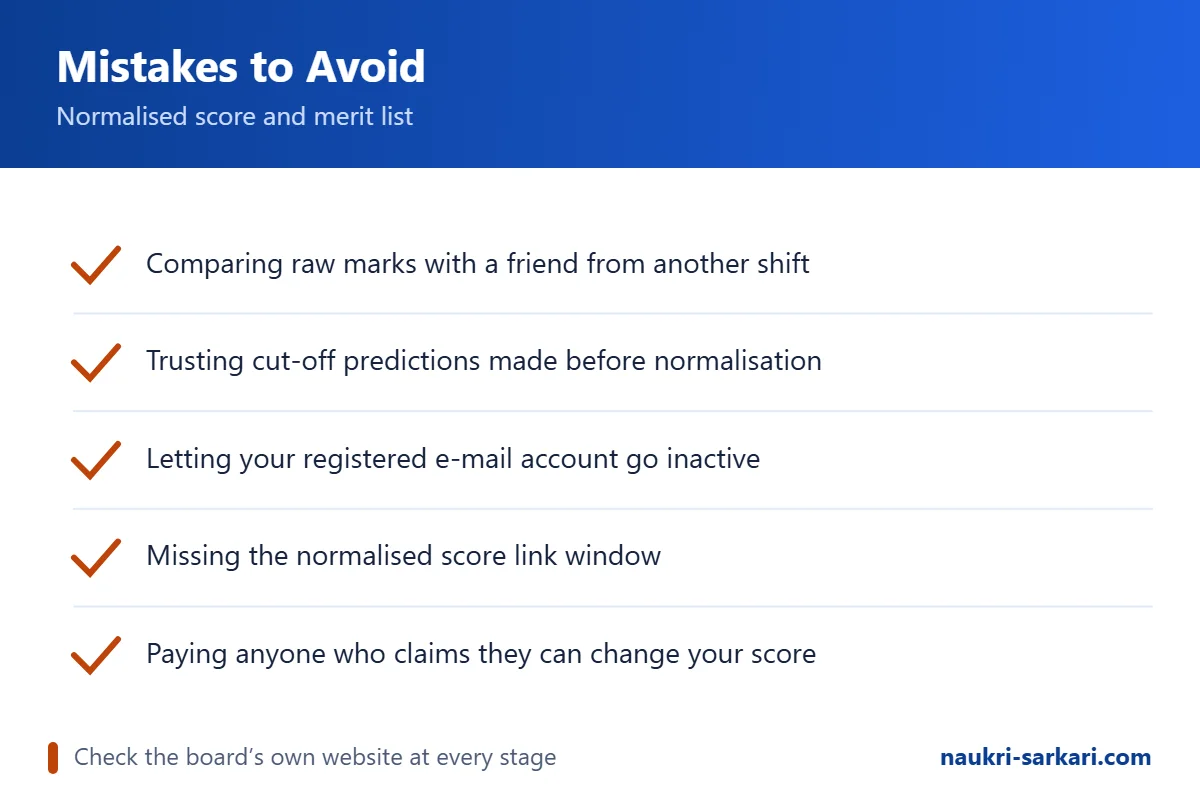
- Comparing your raw marks with a friend from another shift and concluding something about your rank.
- Trusting predicted cut-offs made from raw scores before normalisation is applied.
- Letting your registered e-mail account lapse, since many boards deliver normalised scores only by e-mail.
- Missing the link window because you waited for a reminder that never came.
- Paying anyone who claims they can revise or increase a normalised score. Nobody can.
The habit that protects you is dull but effective: check the board's own website for every stage of your recruitment. Our Result and Admit Card pages collect these notices as they come, and Latest Jobs carries new recruitment notifications.
Where Normalisation Fits in the Exam Cycle
It helps to see the order in which things happen. First the exam is held across shifts. Then the provisional answer key is released and candidates file objections, as in UPSSSC Revised Answer Key 2026 Out for 5 Mains Exams. After objections are settled, a final answer key is used to compute raw scores. Only then is normalisation applied, and the result follows. The normalised score link, when a board provides one, comes last.
Frequently Asked Questions
Is normalisation the same as moderation or grace marks?
No. Grace marks are added for a specific reason, such as a wrong question being dropped. Normalisation is a statistical adjustment across shifts, and it is applied to everyone in the exam.
Can I object to my normalised score?
Objections are normally allowed against the answer key, not against the normalisation. If you see a technical problem with the score shown to you, report it on the helpdesk number the board gives on its portal.
Will the cut-off be in raw marks or normalised marks?
In a multi-shift exam, the cut-off is announced in normalised marks, because that is the scale the merit list is built on.
My shift was very tough. Does that guarantee higher marks after normalisation?
It does not guarantee anything for you personally. The adjustment reflects how the whole shift scored, and your position within your shift still matters.
Where is the exact formula written?
In the official notification or information bulletin for that recruitment. Each board publishes its own method, so do not assume one board's formula applies to another.