


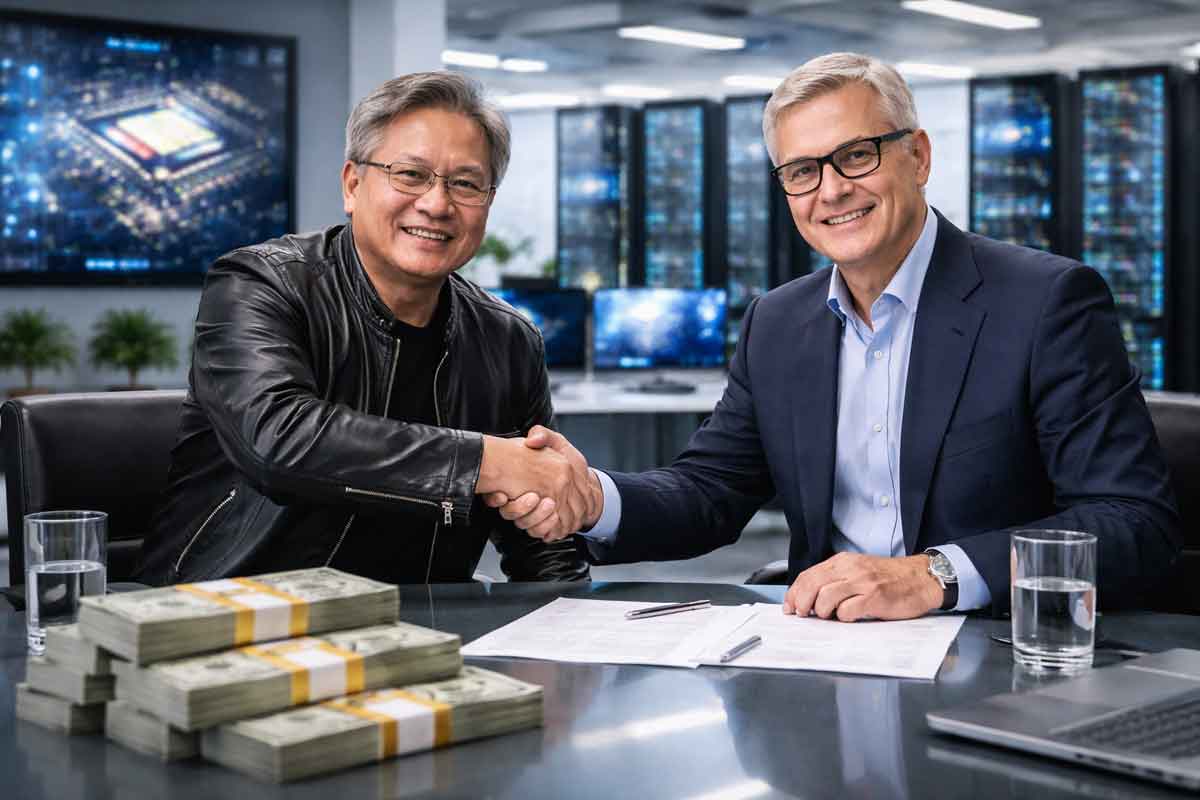
In a transaction that sent ripples across the entire technology sector, AI chip behemoth Nvidia has entered into a landmark agreement with startup Groq, securing a non-exclusive license to its advanced inference technology and bringing its core executive team into the Nvidia fold. The reported price tag for this arrangement is a staggering $20 billion in cash, making it by far the largest deal in Nvidia’s history, dwarfing its previous major acquisitions.
This is no ordinary takeover. The structure of the deal—a licensing agreement rather than a full corporate acquisition—underscores the intense, time-sensitive nature of the AI race. Nvidia is not acquiring Groq as a company; rather, it is paying a monumental sum for immediate access to Groq’s cutting-edge intellectual property and, critically, for its top talent. Groq’s founder and CEO, Jonathan Ross (who was also an early developer of Google’s Tensor Processing Unit, or TPU), along with President Sunny Madra and other senior engineers, will transition to Nvidia. This move immediately strengthens Nvidia’s competitive position in the rapidly expanding market for AI inference chips, where it faces increasing pressure from rivals like Google.
The Value of Speed: Groq’s LPU Technology
The entire deal hinges on what Groq created: the Language Processing Unit, or LPU. Unlike Nvidia’s traditional Graphics Processing Units (GPUs), which are powerful general-purpose chips adapted for AI, Groq’s LPU was designed from the ground up for one specific task: AI inference. Inference is the process where trained AI models, like large language models (LLMs), respond to user queries in real-time. This is distinct from model training, which is a batch-process, compute-intensive task that has long been Nvidia’s domain.
Groq’s architecture achieves its record-breaking, low-latency performance through a fundamentally different design philosophy. It utilizes a software-first approach and a programmable assembly line architecture with high-speed, on-chip SRAM memory, eliminating the memory bandwidth bottlenecks that plague GPU setups. This results in highly deterministic performance—meaning consistent, predictable, and extremely fast response times—which is absolutely vital for real-time applications like advanced chatbots and autonomous systems.
More Than an Acquisition: Talent and Strategy
The unconventional structure—a non-exclusive license for a reported $20 billion—serves multiple strategic purposes for Nvidia. Firstly, it allows Nvidia to sidestep the lengthy and potentially challenging regulatory reviews that a traditional, full acquisition might trigger, given its already dominant position in the AI chip market. Speed of integration is paramount in this sector.
Secondly, the focus on ‘acqui-hiring’ key personnel is arguably the most valuable part of the deal. Groq’s engineers, led by Ross, possess specialized knowledge in building hardware and compilers optimized for sequential, low-latency LLM workloads. By bringing this expertise in-house, Nvidia can rapidly integrate LPU concepts into its own AI factory architecture, extending its platform to serve an even broader range of real-time applications. As Nvidia CEO Jensen Huang noted, the plan is to integrate Groq’s low-latency processors into the NVIDIA AI factory architecture.
What Happens to Groq Now?
Despite the exodus of its founding team and the licensing of its core IP, Groq will continue to operate as an independent entity. Simon Edwards, the former CFO, has stepped into the role of CEO. Crucially, the company’s nascent GroqCloud business, which offers inference-as-a-service to developers, will remain operational without interruption. This ensures that the LPU technology will not be exclusively locked up, which is a key component of the non-exclusive licensing agreement. However, the future trajectory of Groq, stripped of its original leadership and core technology rights, will be under intense scrutiny as it attempts to move forward in the highly competitive AI hardware space.
FAQ
Is Nvidia buying Groq outright?
No. Nvidia is reportedly paying $20 billion for a non-exclusive license to Groq’s AI inference technology and hiring key members of its executive and engineering team, including founder Jonathan Ross. Groq will continue to operate independently.
What is the main benefit of Groq’s LPU technology?
The Language Processing Unit (LPU) is a chip purpose-built for AI inference (running trained models). Its key benefit is providing extremely low latency and deterministic performance, meaning faster, more consistent response times for real-time applications like large language models compared to general-purpose GPUs.
Disclaimer: This article reports on a significant technology licensing and personnel agreement based on multiple news sources, with a reported value of $20 billion. The financial and structural details are based on published reports and may not reflect the full, officially undisclosed terms of the agreement between Nvidia and Groq.
